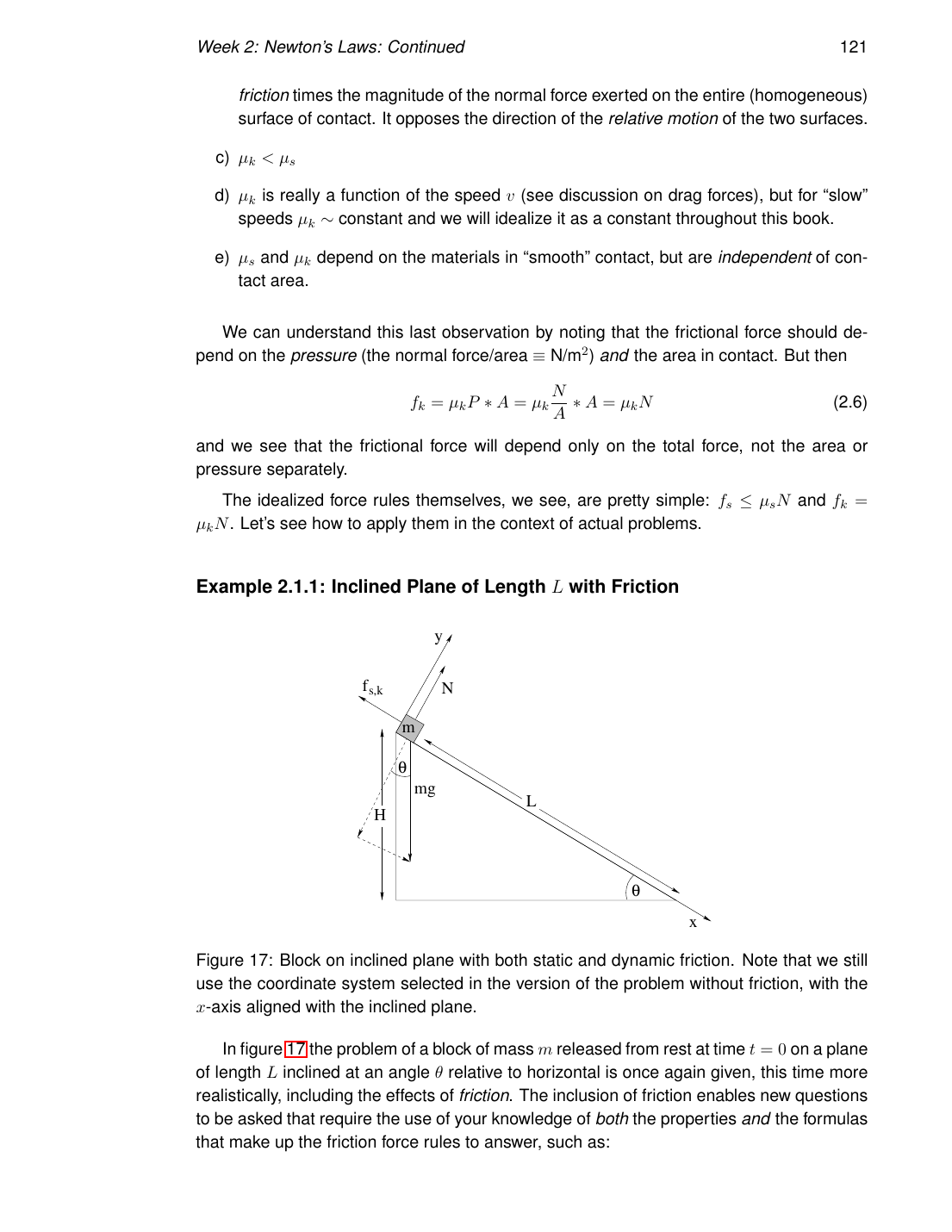
A block sits on a ramp. Tilt the ramp steeper and steeper and — at some angle — the block suddenly gives way and slides down. It's exactly like a book on a tilted table: tilt it enough and the book slides off.
What holds it still until then is friction — the grippy resistance between the block and the ramp. There are two kinds: static friction grips while it's still (and is stronger), and kinetic friction drags once it's already sliding.
Words to know
Inclined plane — a flat surface tilted at an angle (a ramp).
Friction — the grippy resistance between two surfaces that are touching.
Coefficient of friction (µ) — a number for how grippy the two surfaces are: bigger µ = grippier.
Static vs kinetic friction — static grips before it moves (stronger); kinetic drags once it's sliding.
Normal force — how hard the ramp pushes back on the block, straight out of the surface.
Slip (critical) angle — the tilt where static friction finally loses and the block lets go.
Real-world: wheelchair ramps and truck loading ramps, ski and sledding slopes, why a car loses grip on a steep icy hill, and screws and wedges (an inclined plane wrapped around or sharpened to a point).
Ways to view this
Motion — just watch the block on the ramp (the normal view).
Timeline — how far it's slid, drawn over time like a heart-rate monitor: flat while friction holds it, then a curve once it lets go and accelerates.
Motion map — distance slid (across) vs speed (up). You watch the speed climb as it slides further down.
live calculation — plugged in with the current values
▶ release to watch it slide
Critical anglep.122 · eq. 2.12
The tilt where it finally slips — a rougher surface (bigger µs) hangs on to a steeper angle before letting go.
Sliding accelerationp.123
How fast it speeds up once sliding — a steeper ramp speeds it up, friction fights back.
Normal forcep.122
How hard the ramp pushes back on the block — it gets smaller as you tilt the ramp steeper.
What if I change things?
Raise the angle until it lets go — that's the critical angle. More friction holds it longer. A heavier block? Makes no difference — it lets go at the same angle.
Show the math
The block breaks loose when the pull down the slope beats the most static friction can hold:
m·g·sinθ > µs·m·g·cosθ ⟹ tanθ > µs
The mass m cancels on both sides — that's why weight doesn't matter.
Why does it happen?
Friction grips back exactly as hard as needed — but only up to a limit. Past that limit gravity wins and the block accelerates.
Show the math
critical angle: θc = tan⁻¹(µs)
once sliding: a = g(sinθ − µk·cosθ)
Kinetic friction µk is a bit less than static µs, so the moment it lets go it lurches forward.
Why does it matter?
This is literally how you measure friction: tilt a surface until an object just slips, read the angle, take its tangent. That number is µs.
Says who?
Intro Physics 1 — Example 2.1.1, “Inclined Plane of Length L with Friction.”
p.121 setupp.122 θc = tan⁻¹(µs)p.123 a = g(sinθ−µk cosθ)