What is this?
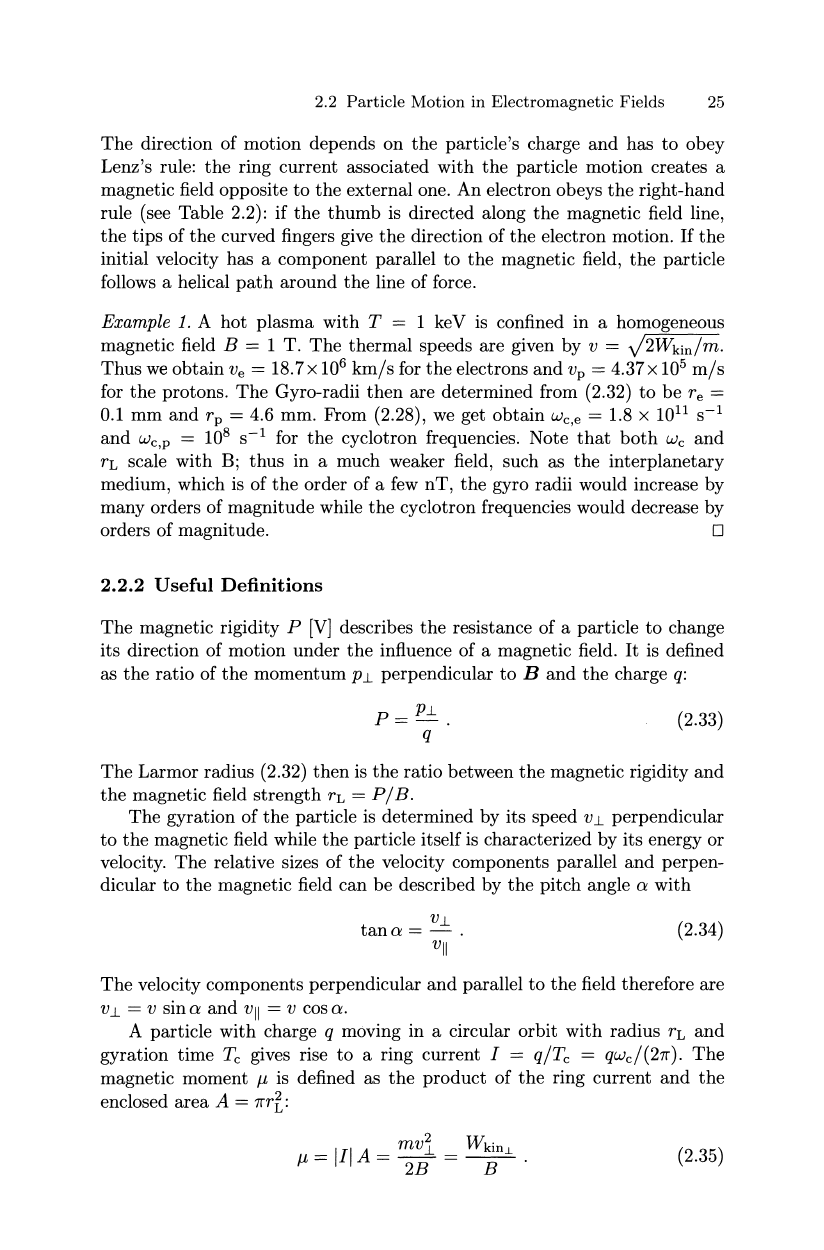
A charged particle — say an electron — flies through a magnetic field. The key idea: a magnetic field never pushes a charge forwards or backwards, only sideways to the way it's moving (the yellow arrow on screen). A steady sideways push bends a straight path into a circle — just like a string swings a ball around your hand. So the particle loops, round and round.
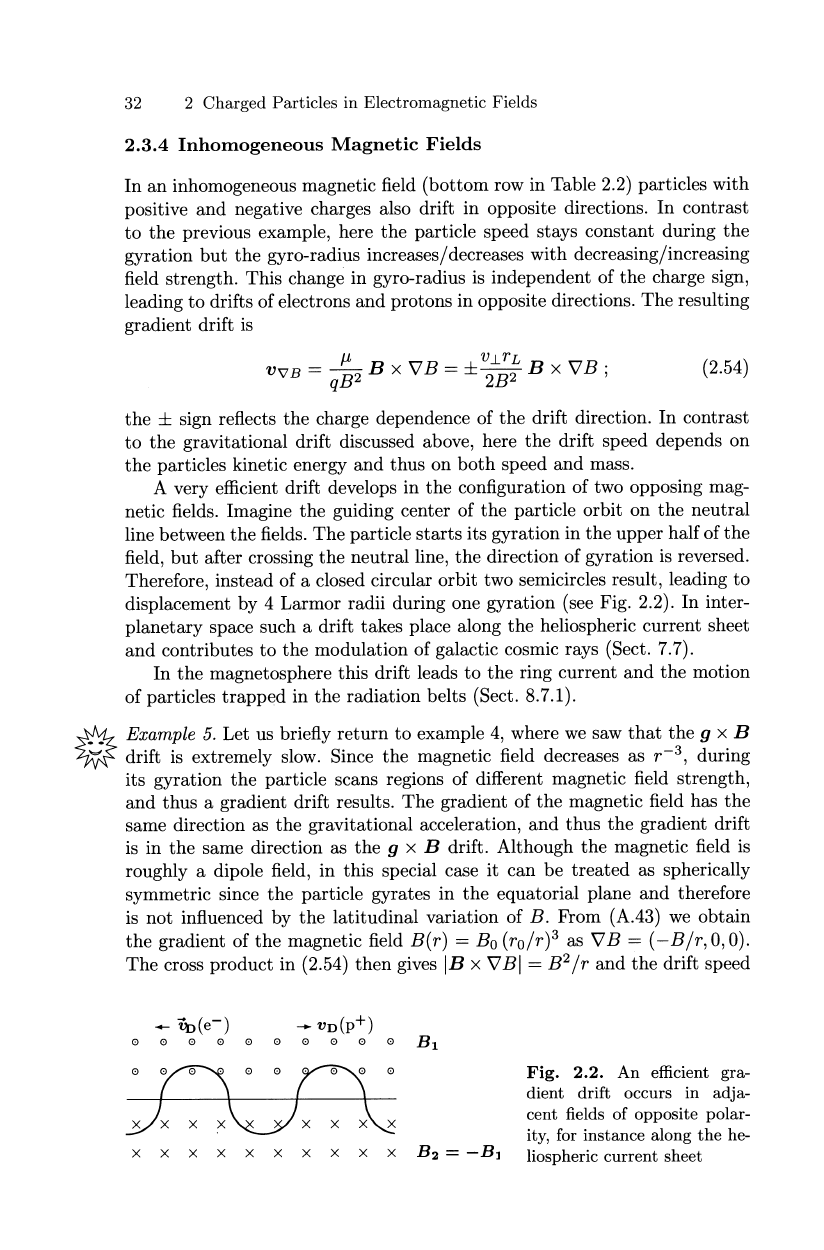
Now switch on an electric field too (that one pushes in a straight line). It speeds the particle up on one half of the loop and slows it on the other, so the loop never quite closes — it creeps sideways a little each lap. That slow sideways creep is the “E×B drift.”
Words to know
Steady / uniform field — the magnetic field is the same strength and direction everywhere.
Field B — how strong that magnetic field is (stronger → tighter, faster circle).
Perp speed v⊥ — how fast the particle moves across the field. It sets the size of the circle.
Gyration — the circular looping motion itself.
E×B drift — add an electric field and the whole circle slides sideways at a steady pace.
Ways to view the SAME particle
Particles — just watch the particle fly along its real path. The most intuitive view. Like watching one particle's streak in a cloud chamber.
Density — real matter isn't one particle, it's trillions. This shows a whole crowd at once as a glowing cloud: bright = lots of particles packed there, dark = few. That's literally what a plasma looks like — a neon sign, the glow of an aurora, the beam in a particle accelerator, or the fuel in a fusion reactor. Why it matters: you never really have one particle — you have a cloud, and its shape is the physics. (Drag Pixel size for smoother or chunkier.)
Timeline — its position drawn over time, scrolling like a heart-rate monitor or a seismograph. Best for seeing the rhythm and history at a glance.
Field-flow — the particle blurred into a continuous flowing field. Physicists model giant plasmas as a fluid (like a weather simulation) instead of tracking every particle. An approximation.
Motion map — position vs speed at the same instant; the shape of the loop tells the story: a closed loop = repeats forever, a spiral = dying out, running off the edge = escaping. Engineers use these for anything that cycles — engines, heartbeats, even predator/prey animal populations.
Earth — the exact same physics as a real planet: a 3D dipole field whose trapped particles are the Van Allen radiation belts, bouncing pole-to-pole, with loss-cone ones lighting the aurora. Drawn on a cellular-automata field so every detail shows.
live calculation — plugged in with the current values
▶ running…
Larmor radiusp.25 · eq. 2.32
The size of the circle it makes — a faster or heavier particle circles wider; a stronger field pulls it tighter.
Gyrofrequencyp.25 · eq. 2.28
How many times a second it loops — a stronger field or lighter particle spins faster (and it doesn't depend on the speed).
Magnetic momentp.25 · eq. 2.40
A quantity that stays fixed as the particle moves into stronger field — it's what forces the mirror to turn it back.
E×B driftp.32 · eq. 2.50
How fast the whole circle slides sideways when you switch on an electric field — the same for any charge.
Why does it happen?
The force q·v×B is always perpendicular to the motion, so it can only turn the particle, never speed it up — that's why the path is a circle. The E×B drift is independent of charge and mass, so electrons and ions drift together.
What is this?
First, what a magnetic field even is: it's invisible, but we draw it as lines — the same curved pattern iron filings make around a fridge magnet. The one rule to remember: where the lines crowd close together, the field is strong; where they spread apart, it's weak.
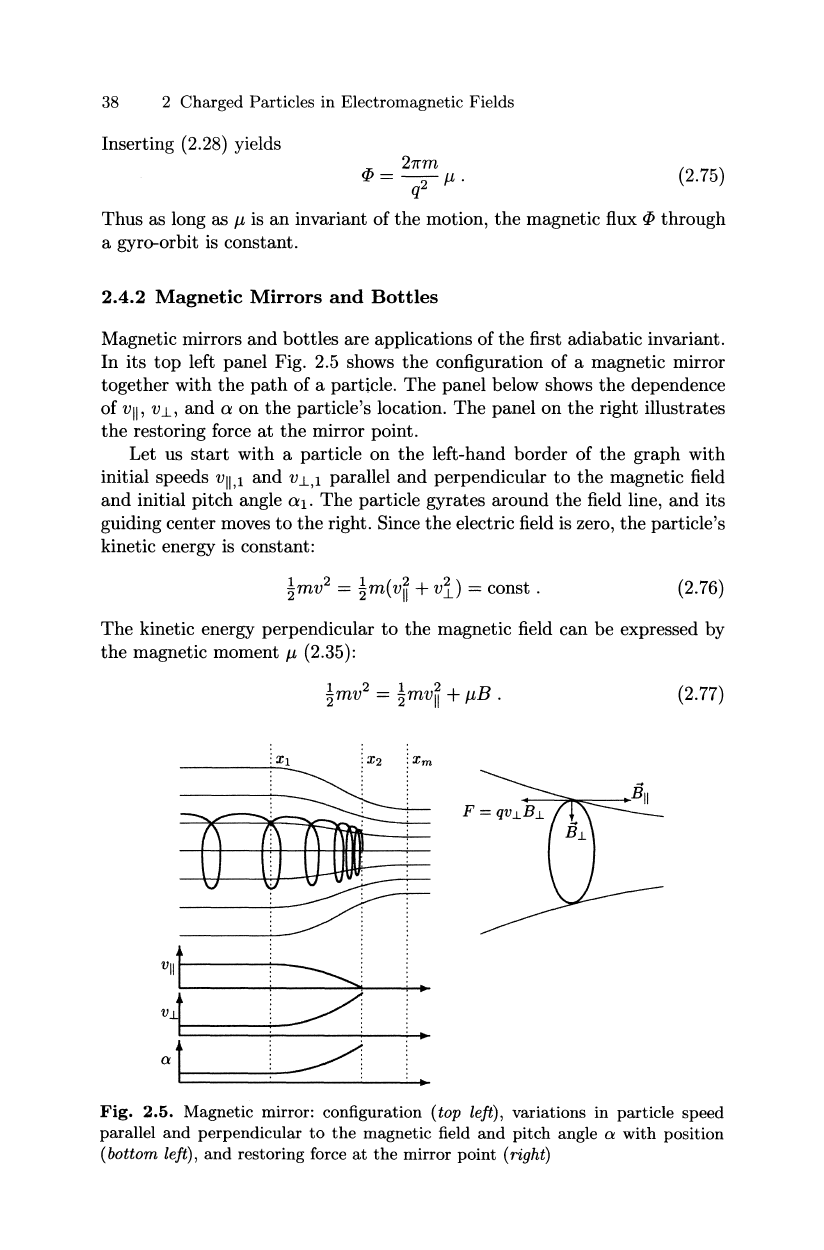
A magnetic bottle is made by putting a strong magnet (a coil) at each end. Right at each coil the field lines pinch tightly together — that's what “squeezed tight” means, the strong field. In between, the lines fan out into a weak field. You can see this on screen: the lines bunch at the two ends and spread in the middle.
Why it bounces: picture a ball rolling in a valley. It rolls freely through the weak middle, but each strong end is like a steep hill it can't climb — so it gets turned back and rolls to the other end, over and over. Trapped.
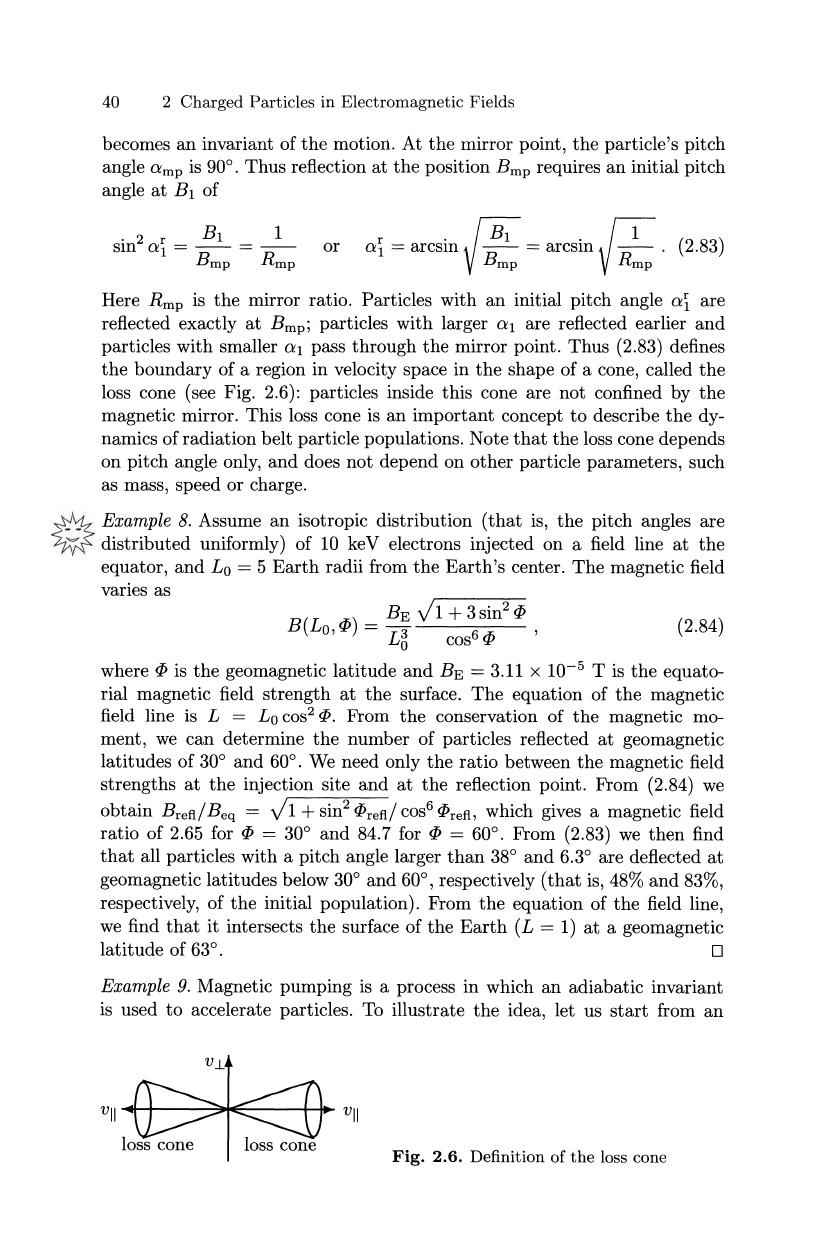
The one escape (the loss cone): that “hill” only shoves back particles that are spiralling across the field. A particle moving almost straight along the field (barely spiralling) has lots of forward speed and little sideways spin, so it just coasts over the hill and out the end. That range of too-straight angles is the loss cone.
Words to know
Magnetic bottle — a field that's weak in the middle and strong at both ends, so particles get trapped inside.
Magnetic mirror — the strong field at each end that reflects the particle back the way it came.
Pitch angle α — how tilted the particle's spiral is: small α = moving nearly straight along the field; large α = spiralling tightly across it.
Mirror ratio — how much stronger the ends are than the middle. Bigger = a better trap.
Loss cone — the range of pitch angles that are too straight to be reflected, so they escape out the end instead of bouncing.
Ways to view the SAME particle
Particles — just watch the particle fly along its real path. The most intuitive view. Like watching one particle's streak in a cloud chamber.
Density — real matter isn't one particle, it's trillions. This shows a whole crowd at once as a glowing cloud: bright = lots of particles packed there, dark = few. That's literally what a plasma looks like — a neon sign, the glow of an aurora, the beam in a particle accelerator, or the fuel in a fusion reactor. Why it matters: you never really have one particle — you have a cloud, and its shape is the physics. (Drag Pixel size for smoother or chunkier.)
Timeline — its position drawn over time, scrolling like a heart-rate monitor or a seismograph. Best for seeing the rhythm and history at a glance.
Field-flow — the particle blurred into a continuous flowing field. Physicists model giant plasmas as a fluid (like a weather simulation) instead of tracking every particle. An approximation.
Motion map — position vs speed at the same instant; the shape of the loop tells the story: a closed loop = repeats forever, a spiral = dying out, running off the edge = escaping. Engineers use these for anything that cycles — engines, heartbeats, even predator/prey animal populations.
Earth — the exact same physics as a real planet: a 3D dipole field whose trapped particles are the Van Allen radiation belts, bouncing pole-to-pole, with loss-cone ones lighting the aurora. Drawn on a cellular-automata field so every detail shows.
live calculation — updates as the particle moves
▶ launch to watch it bounce
Loss-cone anglep.40
The escape angle — if the particle moves too straight along the field, it slips out the end instead of bouncing.
Magnetic moment (invariant)p.25 · eq. 2.40
A quantity that stays fixed as the particle moves into stronger field — it's what forces the mirror to turn it back.
Trapped or lost?p.38–40
Compares the particle's pitch angle to that escape angle to call it trapped or lost.
Why does it happen?
As the particle moves into stronger field, μ stays fixed so v⊥ rises and the forward speed v∥ drops to zero — then it reflects. Watch μ above: it barely changes while the particle bounces.
Space Physics (M.-B. Kallenrode), Ch. 2 — Charged Particles in Electromagnetic Fields.
Click a page to view it full size.