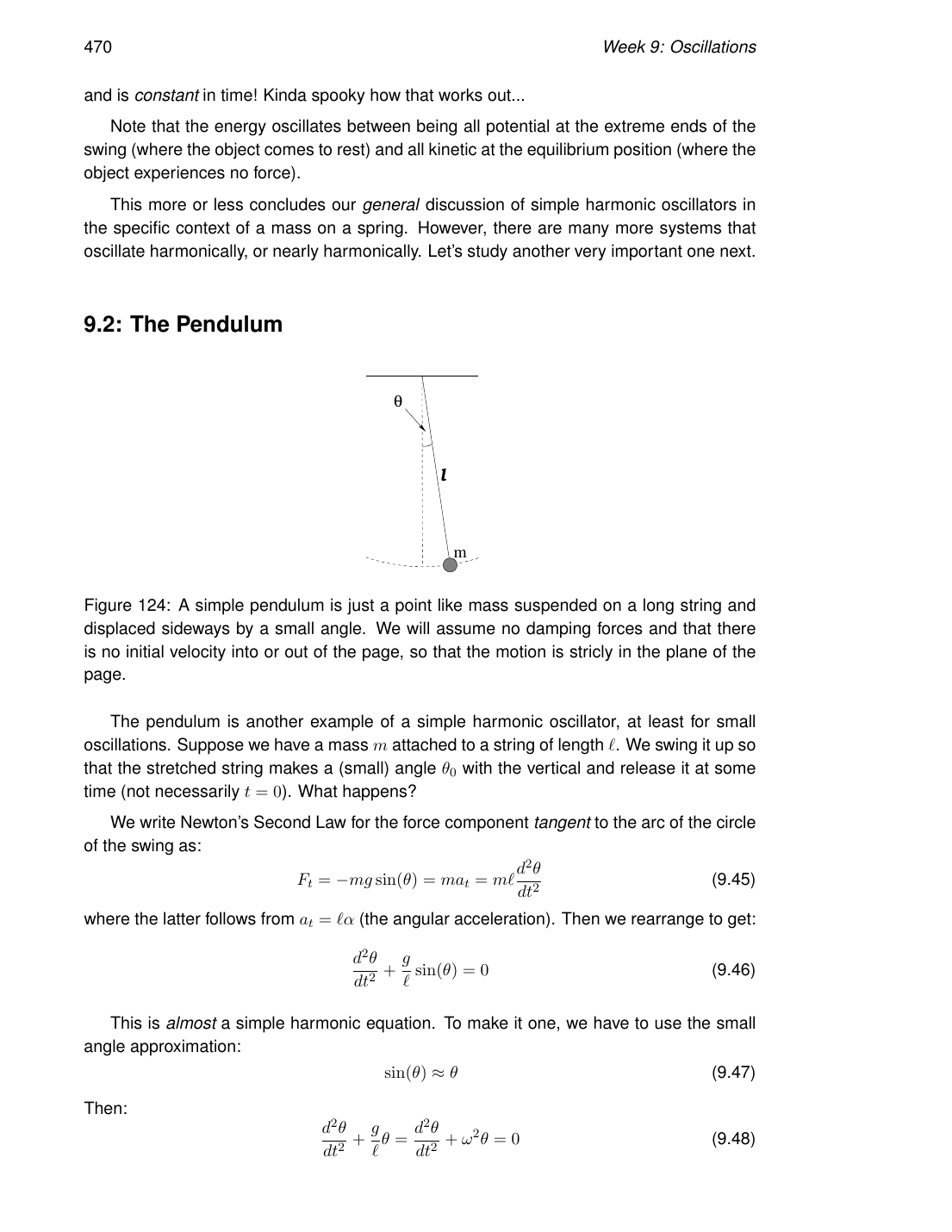
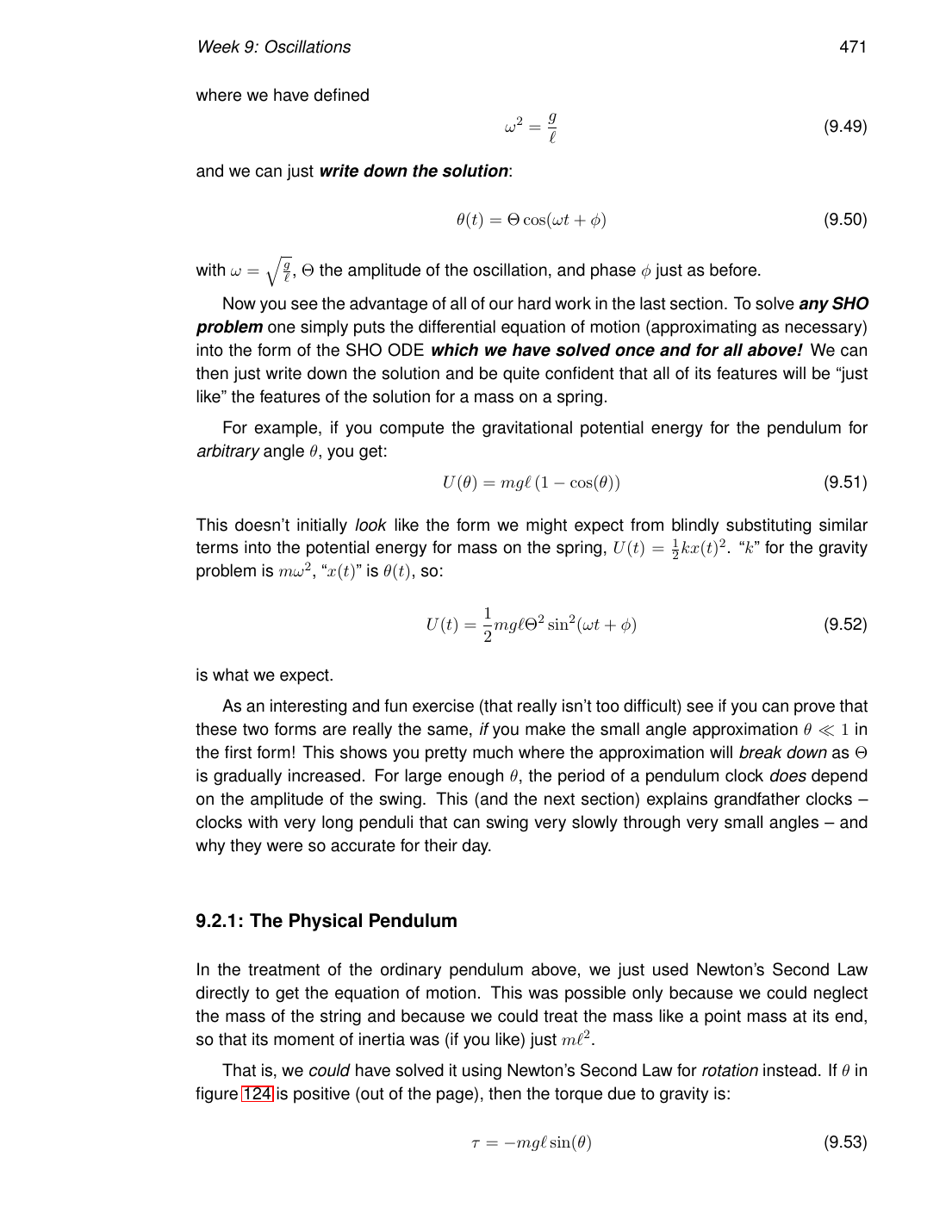
A weight (the bob) hangs from a string and swings back and forth — exactly like a child on a playground swing. Pull it aside, let go, and gravity always pulls it back toward the lowest point (a restoring force), so it sweeps down through the bottom, coasts up the far side, stops, and comes back — over and over.
Words to know
Pendulum — a weight that swings freely from a fixed pivot.
Bob — the swinging weight at the end of the string.
Period — the time for one full back-and-forth swing.
Amplitude — how far to the side it swings (the size of the swing).
Restoring force — gravity always pulling the bob back toward the bottom.
Simple harmonic motion — the smooth, evenly-repeating swing this produces.
Real-world: grandfather clocks keeping time, playground swings, a metronome ticking out a musical beat, a wrecking ball, and a Foucault pendulum whose slow turn reveals the Earth rotating.
Ways to view this
Motion — just watch it swing (the normal view).
Timeline — the angle drawn over time, like a heart-rate monitor: a sine wave.
Motion map — the angle (across) vs how fast it's swinging (up). A closed loop means the swing repeats; big swings trace a fatter "eye" shape.
live calculation — plugged in with the current values
▶ release to watch it swing
Period (small-angle)p.470
How long one full swing takes — a longer string swings slower, and the bob's weight makes no difference.
Speed at the bottomp.471
How fast it's moving at the lowest point — the higher you start it, the faster it whips through the bottom.
Energyp.471
Its total energy — traded between motion (KE) and height (PE), but the total never changes.
What if I change things?
A longer string swings slower. The mass doesn't change the timing at all. A bigger swing is only slightly slower than a small one.
Show the math
For small swings the period depends only on length and gravity:
T = 2π·√(L/g)
No mass anywhere in it — the mass cancels out of the equation of motion, so a heavy bob and a light bob keep the exact same time.
Why does it happen?
Gravity always pulls the bob back toward the bottom. On the way down its height turns into speed; on the way up the speed turns back into height. That trade is what makes it swing.
Show the math
Only the part of gravity along the arc restores it, giving the exact nonlinear equation of motion:
θ'' + (g/L)·sinθ = 0
With no friction, energy is conserved, so the speed at the bottom after release from θ₀ is:
v = √(2gL(1 − cosθ₀))
Why does it matter?
Because the timing depends only on length (not mass, and barely on the swing size), a pendulum keeps steady time — which is exactly how pendulum clocks work.
Says who?
Intro Physics 1 — §9.2, “The Pendulum.”
p.470 equation of motion & T=2π√(L/g)p.471 energy method & solution