A race between something that rolls and something that just slides, released together down the same ramp — like racing a ball against an ice cube down a slide. The slider wins, and here's why: the roller has to spend some of the ramp's energy spinning itself up, so less is left for going fast. The slider spends all of it on speed.
Words to know
Rolling without slipping — the surface grips so the object rolls instead of skidding.
Moment of inertia — how hard it is to get something spinning; mass spread far from the centre spins harder.
Translational vs rotational energy — energy of moving forward vs energy of spinning.
β = I/mr² — the share of the energy that goes into spin instead of speed.
Real-world: car and bike wheels, a bowling ball, why a full can of soup rolls differently than an empty one, gears, and yo-yos.
Ways to view this
Motion — just watch the race down the ramp (the normal view).
Timeline — how far each racer has gone, drawn over time like a heart-rate monitor. The sliding block's line pulls ahead of the roller's — you can see it win.
live calculation — plugged in with the current values
▶ release to watch them race
Rolling accelerationp.293
How fast it speeds up rolling down — the more of its energy goes into spinning (bigger β), the slower it accelerates.
Sliding accelerationp.293
How fast a frictionless slider speeds up — always more than anything that has to roll, because none of its energy is spent spinning.
Bottom speedp.293
Its speed at the bottom — a roller arrives slower because some of the drop's energy went into spinning it up.
What if I change things?
The sliding block always wins. Among rollers a solid sphere beats a disk beats a hoop. Size and weight don't matter — only the shape.
Show the math
The rolling acceleration depends only on the inertia coefficient β = I/mr²:
a = g·sinθ / (1 + β)
β: disk ½ · hoop 1 · sphere ⅖
Smaller β accelerates faster, so the sphere (β=⅖) leads the pack.
Why does it happen?
A roller has to put some of its energy into spinning, so less is left for moving forward. A frictionless block never spins, so it keeps all of gravity's pull.
Show the math
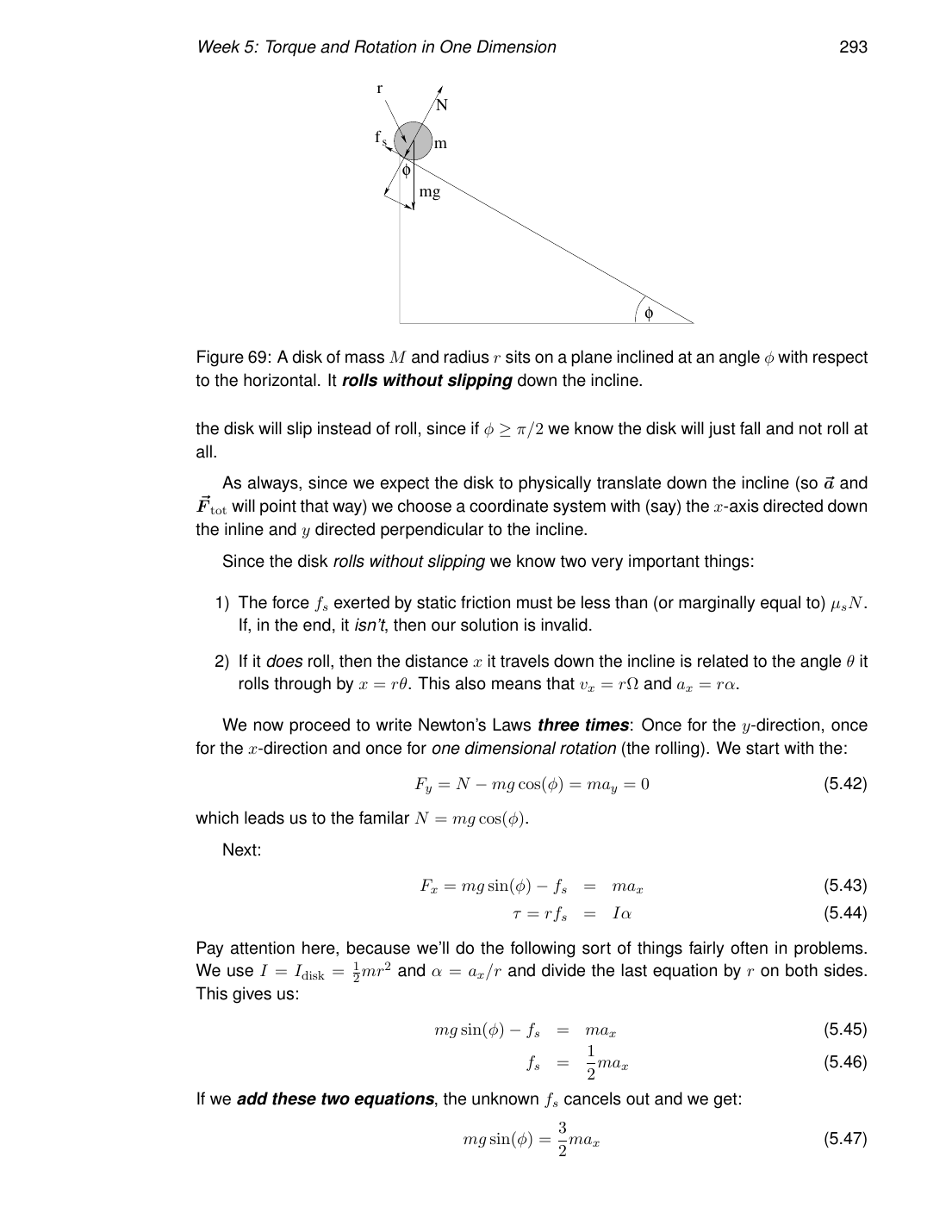
Newton along the slope and the torque about the centre, with a = r·α:
mg·sinθ − f = ma | r·f = Iα
Eliminating f with I = βmr² gives
a = g·sinθ / (1 + β)
and the speed at the bottom after dropping height h:
v = √(2gh/(1+β)) vs √(2gh)
Why does it matter?
It's why hollow vs solid wheels and cans behave differently, and how moment of inertia shows up in the real world.
Says who?
Intro Physics 1 — Example 5.6.1, “A Disk Rolling Down an Incline.”