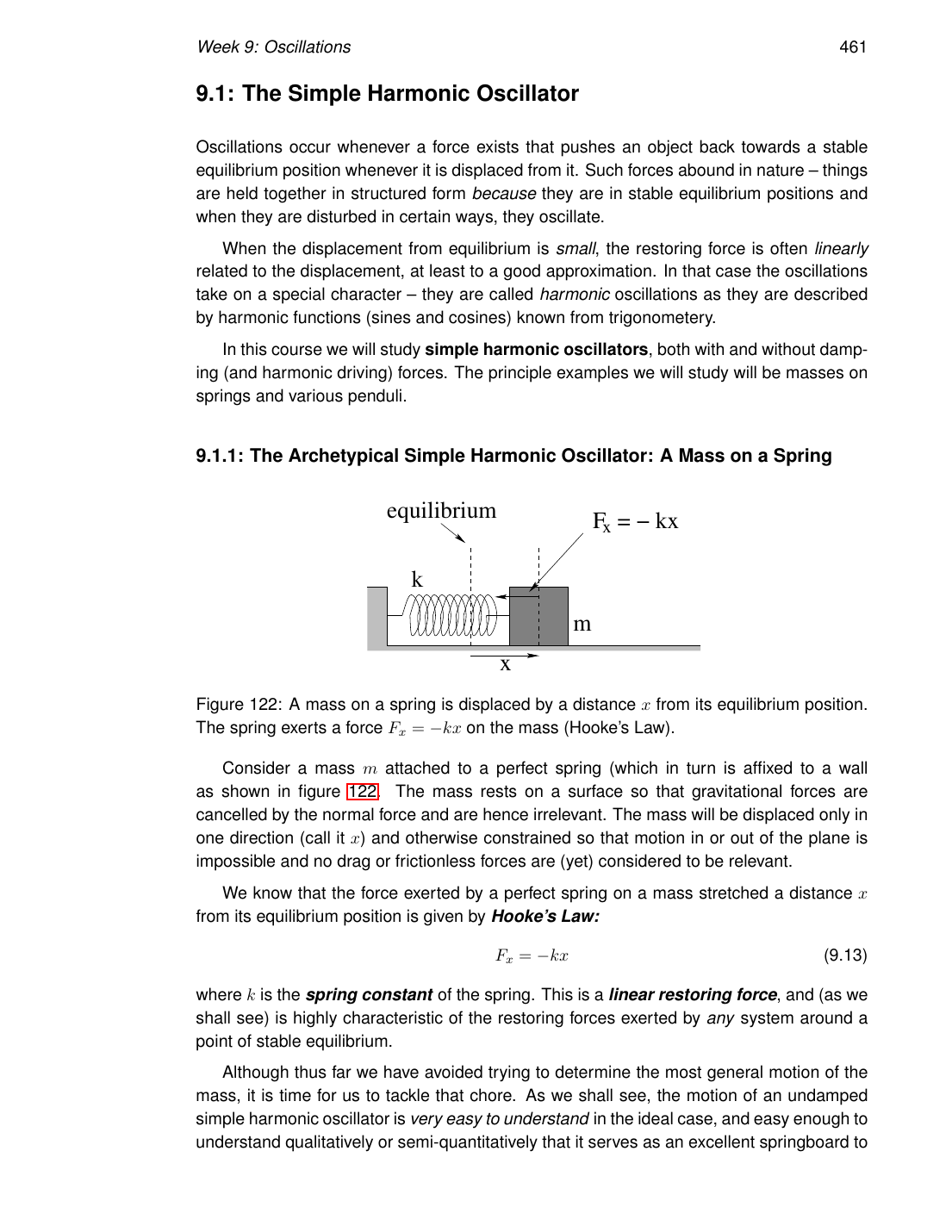
A weight on a spring. Pull it off its resting spot, let go, and it bounces back and forth — like a weight bobbing on a rubber band, or a bathroom scale settling. A spring always pushes or pulls back toward its resting length (a restoring force): the stiffer the spring or the lighter the weight, the faster it bounces. Add damping (friction or air) and each bounce is a little smaller until it settles.
Words to know
Spring constant k — how stiff the spring is: bigger k = stiffer.
Hooke's law — pull it twice as far and it pulls back twice as hard.
Restoring force — the spring always pulling back toward its resting length.
Simple harmonic motion — the smooth, evenly-repeating bounce.
Amplitude — how far it swings from the resting point.
Damping — friction/air that steals energy, shrinking each bounce until it stops.
Real-world: car suspension and shock absorbers, mattress and trampoline springs, the giant dampers that steady skyscrapers in earthquakes, a plucked guitar string, and even atoms vibrating inside a material.
Ways to view this
Motion — just watch the mass bounce (the normal view).
Timeline — its position drawn over time, like a heart-rate monitor: a sine wave that shrinks when damped.
Motion map — position (across) vs speed (up) at the same moment. A closed loop means it repeats forever; a spiral winding inward means friction is draining it to rest.
live calculation — plugged in with the current values
▶ running…
Periodp.462
How long one full bounce takes — a heavier mass is slower, a stiffer spring is faster.
Angular frequencyp.461
The spring's natural rhythm in radians per second (the damped version ω1 is a touch slower).
Energyp.461
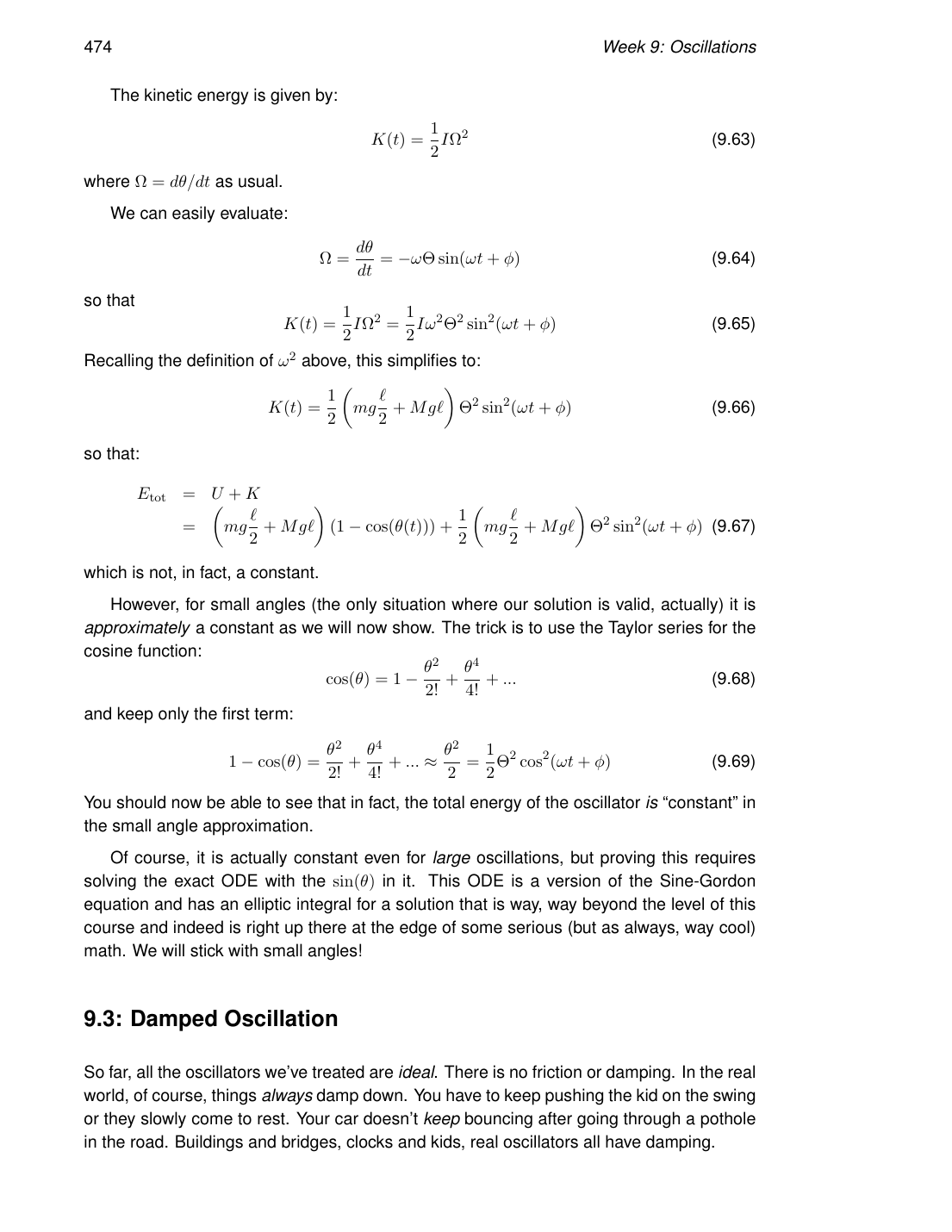
Its total energy — shared between the stretch (PE) and the motion (KE); damping slowly drains it away.
What if I change things?
A stiffer spring makes it swing faster; a heavier mass makes it slower. The size of the bounce doesn't change the timing at all. Add damping and the swings die out.
Show the math
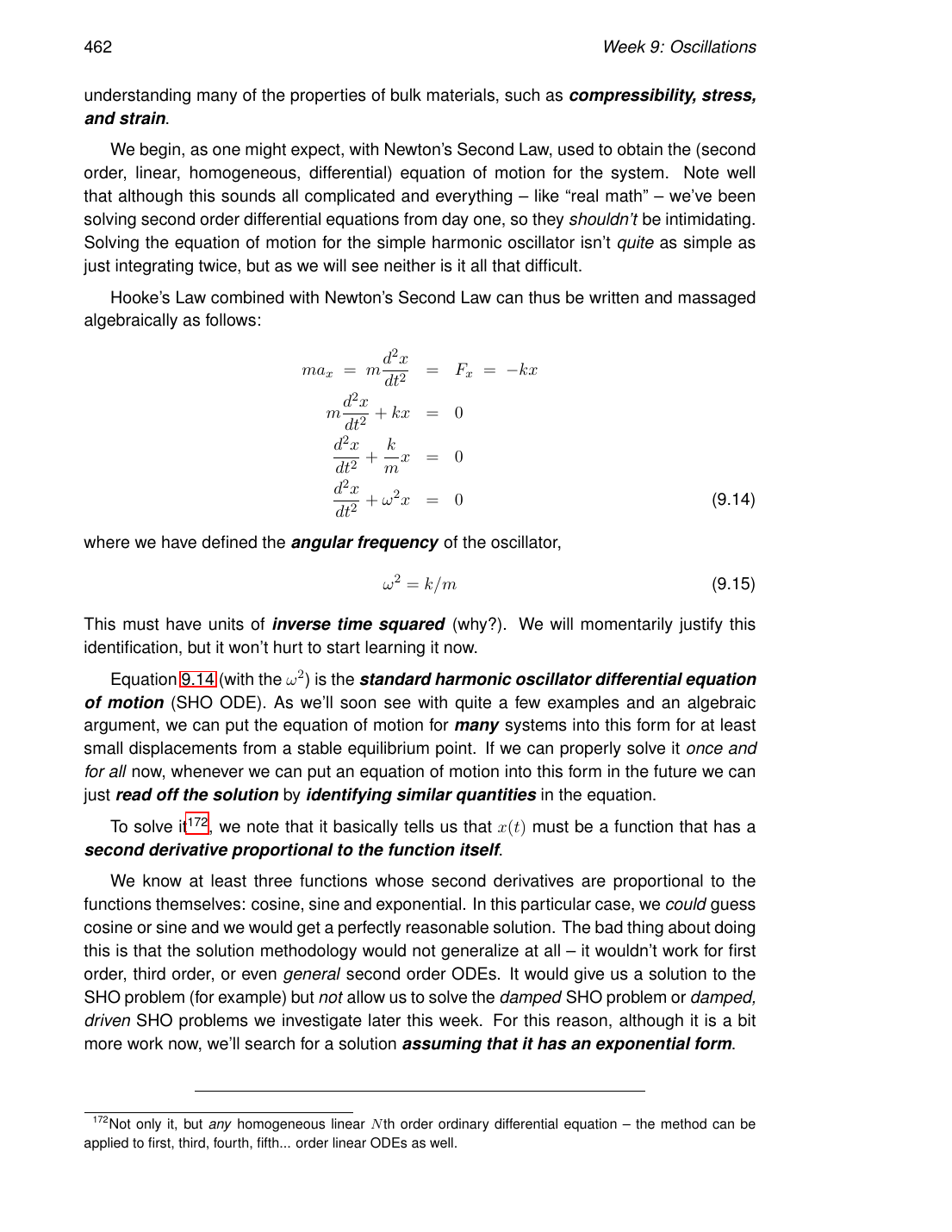
The natural frequency and period depend only on stiffness and mass:
ω0 = √(k/m)
T = 2π√(m/k)
Notice amplitude A appears nowhere — that's why the bounce size doesn't matter.
Why does it happen?
The spring always pulls back toward the middle, and pulls harder the further you pull it — that's Hooke's law, F = −kx. That single "restoring and proportional" rule makes the motion a clean, repeating wobble.
Show the math
Newton's law m·x'' = −k·x rearranges to the signature oscillator equation:
x'' + (k/m)·x = 0
With drag −b·x' added, the amplitude decays under an exponential envelope and the wiggle slows slightly:
A·e^(−(b/2m)t)
ω1 = √(ω0² − (b/2m)²)
Why does it matter?
Every oscillation in physics — atoms in a crystal, current in a circuit, a swaying building — obeys this same equation. Learn the spring and you've learned all of them.